Affiliate disclosure: This article contains affiliate links. If you purchase through these links, Sleep Choice Lab may earn a commission at no additional cost to you. Affiliate relationships do not influence our editorial conclusions.
Last reviewed: 18 October 2026
Table of Contents
Quick Answer
Quick Answer: Which Is Better, YU Sleep or Magnesium Glycinate?
Magnesium glycinate is the simpler choice for people who specifically want to supplement magnesium, while YU Sleep may appeal to those looking for a multi-ingredient sleep formula. However, there is insufficient direct comparative evidence to conclude that YU Sleep works better for sleep.
YU Sleep combines magnesium glycinate with melatonin, L-theanine, lemon balm and other ingredients. Its proprietary blend does not disclose the individual amounts of several ingredients, making it difficult to assess their potential effectiveness.
Magnesium glycinate provides a more straightforward approach, although scientific evidence for its sleep benefits is also limited.
Bottom line: Neither supplement is proven superior for everyone. The better choice depends on your sleep concerns, ingredient preferences, budget and individual health circumstances.
Considering YU Sleep? Before deciding, read our YU Sleep Price, Discounts & Where to Buy (2026) guide. It compares the advertised package prices, shipping offers and refund conditions so you can make a more informed purchasing decision.
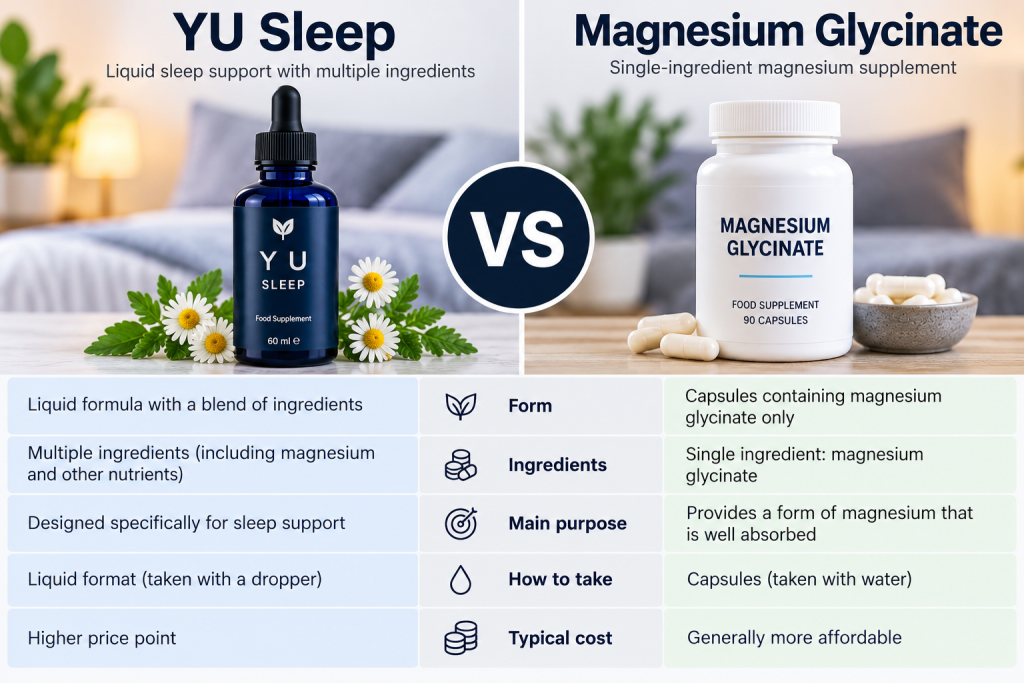
Illustrative comparison graphic. Product packaging is for illustration only and may not represent actual products.
YU Sleep vs Magnesium Glycinate at a Glance
| Feature | YU Sleep | Magnesium Glycinate |
| Product type | Multi-ingredient sleep supplement | Single-ingredient magnesium supplement |
| Main approach | Combines several sleep-related ingredients | Provides magnesium in glycinate form |
| Number of active ingredients | Multiple ingredients | Primarily one active ingredient: magnesium |
| Scientific evidence | Research exists on individual ingredients, but no clinical trial of the complete formula was verified | Some promising studies, but overall evidence for sleep benefits remains limited and inconsistent |
| Best suited to | People who prefer a multi-ingredient sleep formula | People who specifically want magnesium supplementation |
| Main advantage | Convenience of several ingredients in one formula | Simpler formulation with fewer ingredients |
| Magnesium dosage transparency | Individual magnesium amount not disclosed in the proprietary blend | Magnesium amount is generally stated on the Supplement Facts label |
What Is YU Sleep?
YU Sleep is a dietary supplement designed to support sleep using a combination of several ingredients rather than relying on a single compound. Its formula includes magnesium glycinate alongside ingredients commonly found in sleep supplements, such as melatonin, L-theanine, GABA, 5-HTP, lemon balm, apigenin and tart cherry. Because supplement formulations can change, the current product label should always be checked for the exact ingredients and amounts.
According to the YU Sleep Supplement Facts label reviewed on 18 October 2026, one 2 mL serving contains 0.9 mg of melatonin, 0.5 mg of vitamin B2, 0.5 mg of vitamin B6 and a 637 mg proprietary blend. The blend includes red tart cherry concentrate, magnesium glycinate, apigenin, lemon balm extract, 5-HTP, L-theanine and GABA.
Important limitation: The manufacturer does not disclose the individual quantities of ingredients within the 637 mg proprietary blend. Therefore, it is not possible to determine how much magnesium glycinate or elemental magnesium each serving provides from this label alone. This makes a direct magnesium dosage comparison with standalone magnesium glycinate supplements impossible.
Source: YU Sleep — Supplement Facts and Ingredients
Interested in YU Sleep? You can view the product details, ingredients and current pricing on the official YU Sleep website. (Affiliate link)
What Is Magnesium Glycinate?
Magnesium glycinate is a form of magnesium in which magnesium is bound to the amino acid glycine. It is commonly sold as a dietary supplement and is often marketed for relaxation and sleep support. Some research suggests magnesium supplementation may improve certain measures of sleep, particularly in people with low magnesium status, but the overall evidence remains limited and inconsistent. Magnesium glycinate should therefore not be considered a proven treatment for insomnia.
YU Sleep vs Magnesium Glycinate: Key Differences
1. YU Sleep Uses Multiple Ingredients
The biggest difference is the formulation. Magnesium glycinate supplements mainly provide magnesium, while YU Sleep combines magnesium glycinate with several other ingredients associated with sleep or relaxation. This means YU Sleep takes a broader multi-ingredient approach, but it also makes it more difficult to determine which individual ingredient is responsible for any effect a user experiences.
2. Magnesium Glycinate Is a Simpler Approach
A standalone magnesium glycinate supplement has a simpler formulation. This can make it easier to identify how much magnesium you are taking and to assess whether it is providing any noticeable benefit. It also avoids taking several additional sleep-related ingredients at the same time when they may not be necessary.
3. The Evidence Is Different
The scientific evidence should be considered separately from product marketing. Magnesium has been studied for its potential relationship with sleep, but research has produced mixed results and the overall evidence remains limited. YU Sleep contains several ingredients that have also been studied individually, but evidence for an individual ingredient does not automatically prove that the complete YU Sleep formula will produce the same effect.
4. Cost and Value Can Be Very Different
YU Sleep is a multi-ingredient supplement, while standalone magnesium glycinate products are generally simpler formulations. Their prices vary depending on the brand, package size, serving count and available discounts. A fair comparison should consider the cost per serving rather than just the bottle price. YU Sleep’s proprietary blend also makes it difficult to compare the cost of magnesium itself because the individual magnesium quantity is not disclosed. Check current prices and serving information before purchasing either product.
5. YU Sleep Has More Potential for Ingredient Interactions
Because YU Sleep combines several active ingredients, there are more substances to consider when checking for possible side effects or interactions with medicines and other supplements. A standalone magnesium glycinate product has fewer active ingredients, although magnesium itself can still interact with certain medicines. Anyone taking medication, managing a medical condition, or unsure whether a supplement is suitable for them should check with a qualified healthcare professional.
What Does the Research Say About Magnesium and Sleep?
Research into magnesium and sleep has produced mixed results. A 2026 systematic review of randomized controlled trials found that magnesium may provide modest benefits for some sleep outcomes in some adults, but results were inconsistent and the overall certainty of the evidence was low to very low. A 2025 randomized placebo-controlled trial involving 155 adults with poor sleep found that magnesium bisglycinate produced a small improvement in insomnia severity after four weeks. Taken together, the evidence suggests that magnesium may help some people, but it should not currently be considered a proven or routine treatment for insomnia.
2026 systematic review on PubMed
2025 magnesium bisglycinate trial on PubMed
What Does the Research Say About YU Sleep?
YU Sleep contains several ingredients that have been studied individually for their potential effects on sleep, including melatonin, magnesium, L-theanine, GABA and tart cherry. However, research on individual ingredients should not be treated as proof that the complete YU Sleep formula produces the same results. At the time of our research, we could not verify a peer-reviewed clinical trial testing the complete YU Sleep formula itself. This means the scientific case for the product currently relies largely on research into its individual ingredients rather than direct clinical evidence for the finished formula.
Which Is Better: YU Sleep or Magnesium Glycinate?
Neither option is automatically better for everyone. Magnesium glycinate is the simpler choice for someone who specifically wants to supplement magnesium and prefers a product with fewer active ingredients. YU Sleep may appeal more to someone who wants the convenience of several sleep-related ingredients combined in one formula. However, the additional ingredients also increase complexity, cost and the number of potential interactions to consider. Based on the available research, there is not enough direct clinical evidence to conclude that the complete YU Sleep formula is more effective for sleep than magnesium glycinate alone.
Who Might Prefer Magnesium Glycinate?
Magnesium glycinate may appeal to people who want a simpler supplement and specifically want to increase their magnesium intake. Compared with a multi-ingredient formula, it is easier to see exactly what you are taking and to avoid additional sleep-related ingredients you may not want or need. It may also be less expensive, depending on the product and dosage.
- Prefer a simpler, single-purpose supplement
- Specifically want magnesium supplementation
- Want fewer active ingredients to consider
- Prefer to evaluate one supplement at a time
- Want a potentially lower-cost option
Who Might Prefer YU Sleep?
YU Sleep may appeal to people who prefer the convenience of taking several sleep-related ingredients in a single formula rather than purchasing and taking multiple supplements separately. However, convenience should be weighed against the higher cost, more complex ingredient list and the fact that evidence for individual ingredients does not necessarily demonstrate the effectiveness of the complete formula.
- Prefer an all-in-one sleep supplement
- Want several sleep-related ingredients in one product
- Prefer convenience over taking multiple separate supplements
- Are comfortable with a more complex ingredient formula
- Are willing to pay more for an all-in-one product
Side Effects and Safety Considerations
Magnesium supplements can cause side effects such as diarrhoea, nausea and abdominal cramping, particularly at higher supplemental doses. Magnesium can also interact with certain medicines. Because YU Sleep contains multiple active ingredients, its safety considerations depend on the complete formula, not magnesium alone. Some ingredients may cause drowsiness or interact with medicines or other supplements. Anyone who is pregnant or breastfeeding, takes medication, has a medical condition, or has concerns about supplement use should speak with a qualified
NCCIH — Melatonin: What You Need To Know
NIH — Magnesium: Fact Sheet for Consumers
Additional safety considerations: YU Sleep contains melatonin and 5-HTP, which require particular attention when combined with certain medications. Melatonin may cause daytime drowsiness and interact with some medicines, including sedatives and anticoagulants. 5-HTP may interact with medicines that increase serotonin, including certain antidepressants, potentially causing a serious condition known as serotonin syndrome. People taking prescription medication should consult a qualified healthcare professional before using YU Sleep. The safety of the complete multi-ingredient formula should not be assumed from research on its individual ingredients.
Frequently Asked Questions
Does YU Sleep contain magnesium glycinate?
Yes. YU Sleep lists magnesium glycinate as one of the ingredients in its multi-ingredient sleep formula. However, formulations can change, so check the current product label for the latest ingredient list and amounts.
Is magnesium glycinate better than YU Sleep?
Not necessarily. Magnesium glycinate is a simpler option containing fewer active ingredients, while YU Sleep combines magnesium glycinate with several other sleep-related ingredients. Which approach is more suitable depends on what someone wants from a supplement. There is currently insufficient direct clinical evidence to conclude that the complete YU Sleep formula is more effective for sleep than magnesium glycinate alone.
Can you take YU Sleep and magnesium glycinate together?
Taking them together could increase your total magnesium intake because YU Sleep already contains magnesium glycinate. It could also mean combining multiple supplements unnecessarily. Check the amount of magnesium provided by each product and speak with a qualified healthcare professional if you are unsure whether combining them is appropriate, particularly if you take medication or have a medical condition.
Does magnesium glycinate actually help you sleep?
Possibly, but the evidence is not strong enough to say that magnesium glycinate reliably improves sleep for everyone. Some clinical research has found small improvements in sleep or insomnia symptoms, while other studies have produced inconsistent results. The benefits may also depend on factors such as a person’s magnesium status, dose and individual circumstances.
Is YU Sleep worth the extra cost compared with magnesium glycinate?
The extra cost mainly pays for the convenience of having several sleep-related ingredients combined in one formula. Whether that represents good value depends on whether you actually want those additional ingredients. Someone interested primarily in magnesium may find a standalone magnesium glycinate supplement more economical, while someone specifically looking for an all-in-one formula may value the convenience of YU Sleep.
The Bottom Line: YU Sleep vs Magnesium Glycinate
YU Sleep and magnesium glycinate offer two different approaches. Magnesium glycinate provides a simpler way to supplement magnesium, while YU Sleep combines magnesium glycinate with several additional sleep-related ingredients in one formula. Current research provides some evidence that magnesium supplementation may help certain people, but the overall evidence remains mixed, and we could not verify clinical research demonstrating that the complete YU Sleep formula is more effective than magnesium glycinate alone. The better fit therefore depends on whether you value a simple magnesium supplement or the convenience of a multi-ingredient formula.
Learn more about our research standards on our Editorial Policy page.