Affiliate disclosure: This article contains affiliate links. If you purchase through these links, Sleep Choice Lab may earn a commission at no additional cost to you. Affiliate relationships do not influence our editorial conclusions.
Last reviewed: 21 October 2026
Quick Answer: Does YU Sleep Work?
Does YU Sleep work? The most accurate answer is that some of its ingredients have been studied for sleep, but there is not enough publicly verified clinical evidence to conclude that the complete YU Sleep formula reliably improves sleep.
YU Sleep combines melatonin with several other ingredients commonly marketed for relaxation and sleep support. Melatonin has some evidence for helping certain sleep-related problems, particularly those involving sleep timing. However, research on individual ingredients does not automatically prove that a multi-ingredient supplement works.
Another important limitation is that YU Sleep uses a proprietary blend. The label identifies the ingredients but does not disclose how much of each blended ingredient is included.
Our verdict: YU Sleep is an interesting multi-ingredient supplement, but its effectiveness as a finished product remains uncertain. Consumers should consider the available evidence, ingredient transparency, potential interactions and price before buying.
Is YU Sleep Worth Buying? Our Verdict
YU Sleep may be worth considering for adults who occasionally struggle to fall asleep and prefer a liquid supplement containing several sleep-supporting ingredients. Its formula includes melatonin, magnesium glycinate, L-theanine and other ingredients associated with sleep and relaxation.
However, there is currently insufficient independent clinical evidence showing that the complete YU Sleep formula works better than simpler alternatives.
Our verdict: YU Sleep could appeal to people looking for a convenient, multi-ingredient sleep supplement, but it isn’t necessarily the best choice for everyone. Consider the ingredients, possible medication interactions, price and refund terms before purchasing.
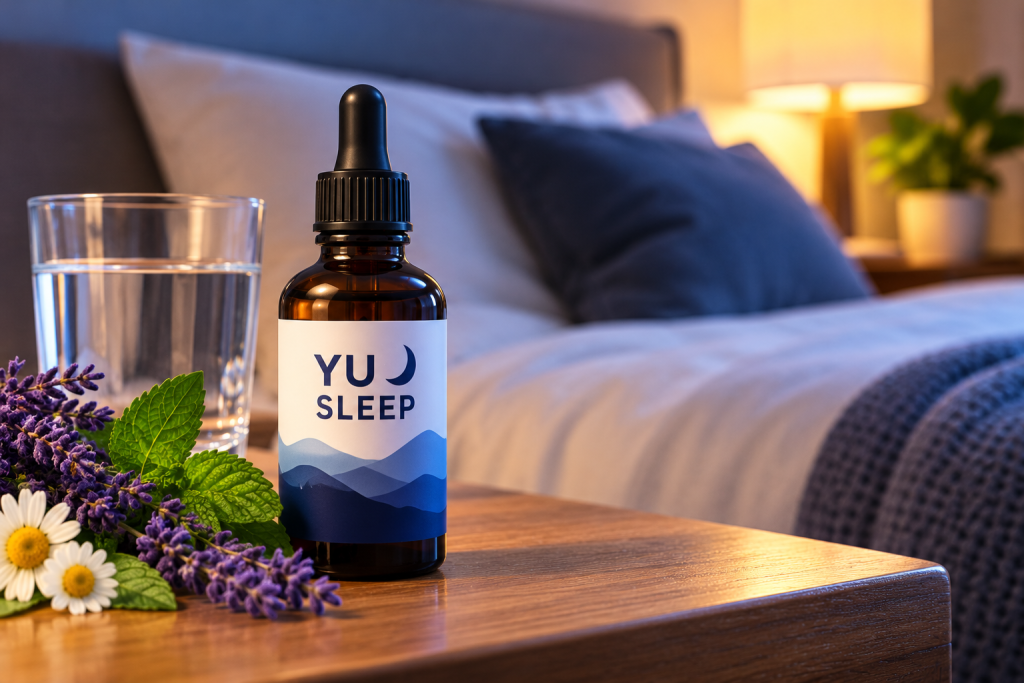
What Is YU Sleep?
YU Sleep is a liquid sleep-support supplement marketed as a convenient alternative to taking several separate products.
According to the product information reviewed, a 2 mL serving contains:
- Melatonin — 0.9 mg
- Vitamin B2 — 0.5 mg
- Vitamin B6 — 0.5 mg
- Proprietary blend — 637 mg
The proprietary blend lists red tart cherry concentrate, magnesium glycinate, apigenin, lemon balm extract, 5-HTP, L-theanine and GABA.
The main attraction is convenience: multiple ingredients are combined into one liquid formula. But having more ingredients does not necessarily mean a supplement is more effective.
Importantly, the 637 mg figure refers to the combined weight of the proprietary blend, not the amount of magnesium or any other individual ingredient.
YU Sleep Ingredients: What Does the Evidence Say?
Melatonin
Melatonin is a hormone involved in regulating the body’s sleep–wake cycle.
Supplemental melatonin may help with certain sleep-timing problems, such as jet lag. Some studies also suggest a modest reduction in the time it takes to fall asleep.
However, evidence is less convincing for chronic insomnia, and major clinical guidelines do not recommend melatonin as a routine treatment for that condition.
YU Sleep lists 0.9 mg of melatonin per serving. This is a disclosed amount, but the presence of melatonin alone cannot establish how well the complete product works.
Magnesium Glycinate
Magnesium is an essential mineral involved in normal nerve and muscle function.
Magnesium glycinate combines magnesium with the amino acid glycine. It is often marketed for relaxation and sleep support.
Research into magnesium supplementation and sleep has produced mixed results. Some studies report small improvements, but the overall evidence remains limited.
A particular issue with YU Sleep is that the label does not disclose the amount of magnesium glycinate or elemental magnesium within its proprietary blend.
That makes it difficult to compare its magnesium content with a dedicated magnesium supplement.
L-Theanine
L-theanine is an amino acid found naturally in tea.
Some research suggests it may support relaxation or certain aspects of sleep quality. However, studies differ in their doses, participants and outcomes.
Because YU Sleep does not disclose its L-theanine quantity, it is impossible to determine whether a serving provides an amount comparable with doses used in clinical research.
Lemon Balm
Lemon balm is an herb traditionally used for relaxation.
Small studies have explored its effects on stress, anxiety and sleep-related outcomes, sometimes in combination with other ingredients.
The results are not strong enough to establish that lemon balm will reliably improve sleep for everyone.
Its undisclosed quantity in YU Sleep also limits meaningful comparisons with published studies.
Apigenin
Apigenin is a naturally occurring plant compound found in foods and herbs, including chamomile.
It has attracted interest for possible calming effects, but direct human evidence supporting isolated apigenin as an effective sleep treatment remains limited.
Laboratory findings and traditional uses should not be confused with proof of clinical effectiveness.
Tart Cherry Concentrate
Tart cherry products have been studied for possible effects on sleep duration and quality.
Some small studies have reported encouraging results, but the research varies considerably in product type, concentration and study design.
YU Sleep’s tart cherry quantity is not disclosed separately, so findings from specific tart cherry studies cannot be directly applied to its formula.
5-HTP
5-hydroxytryptophan, or 5-HTP, is involved in the body’s production of serotonin.
It is sometimes marketed for mood and sleep support, but robust clinical evidence for treating insomnia is lacking.
It also deserves particular caution because it can interact with medicines that affect serotonin, including certain antidepressants.
GABA
Gamma-aminobutyric acid, or GABA, is an inhibitory neurotransmitter involved in nervous-system signalling.
Oral GABA supplements are marketed for relaxation, but evidence for meaningful improvements in sleep remains limited and inconsistent.
The effects of supplemental GABA should not be assumed to be the same as the effects of GABA naturally produced in the brain.
Does the Complete YU Sleep Formula Have Clinical Evidence?
This is the most important question in evaluating YU Sleep.
Research on an ingredient is not the same as research on a finished supplement.
For example, a study examining a particular dose of L-theanine cannot prove that YU Sleep provides the same benefit, especially when the amount of L-theanine in the product is not disclosed.
The same applies to magnesium, tart cherry, lemon balm and the other blended ingredients.
At the time of this review, we could not verify a published, peer-reviewed, placebo-controlled human clinical trial demonstrating the effectiveness of the complete YU Sleep formula.
That does not prove the product is ineffective. It means that strong conclusions about its effectiveness would be premature.
The Proprietary Blend: Why Ingredient Transparency Matters
YU Sleep discloses the total weight of its proprietary blend as 637 mg per serving.
However, it does not specify the individual amounts of the seven ingredients within that blend.
This creates three limitations:
- Consumers cannot easily compare the amounts with doses studied in research.
- People who already take certain supplements may struggle to assess their combined intake.
- Independent reviewers cannot accurately evaluate whether the formula contains meaningful quantities of each ingredient.
Proprietary blends are not unique to YU Sleep, and their use does not automatically indicate poor product quality.
Nevertheless, full ingredient disclosure would make the product easier to evaluate.
YU Sleep Benefits: What Can Consumers Realistically Expect?
Based on the ingredients, YU Sleep is positioned as a supplement for people interested in sleep support and relaxation.
Some individuals may experience subjective benefits. Others may notice little or no difference.
Without strong clinical evidence for the complete formula, it is not possible to reliably predict how much improvement users might experience or which ingredients would be responsible.
Claims about falling asleep dramatically faster, eliminating insomnia or guaranteeing uninterrupted sleep would go beyond the evidence reviewed here.
Persistent sleep problems can have many causes, including stress, irregular schedules, sleep apnoea, medication effects and underlying medical conditions.
A supplement is not a substitute for identifying and addressing those causes.
YU Sleep Side Effects and Safety Considerations
Although YU Sleep contains ingredients often described as natural, natural does not necessarily mean risk-free.
Melatonin may cause daytime drowsiness, headaches or other side effects. It can also interact with certain medicines.
Magnesium supplements can cause digestive symptoms, particularly at higher supplemental doses. The amount of magnesium in YU Sleep’s blend is not individually disclosed.
5-HTP requires particular caution. Combining it with antidepressants or other substances that increase serotonin may increase the risk of serious adverse effects, including serotonin syndrome.
Other ingredients may also cause unwanted effects or interact with medications.
People who are pregnant or breastfeeding, take prescription medication, have medical conditions or are considering combining several sleep supplements should seek advice from a qualified healthcare professional before using YU Sleep.
Avoid driving or operating machinery if a sleep product causes drowsiness.
For persistent insomnia, speak with a healthcare professional rather than relying on supplements alone.
YU Sleep vs Magnesium Glycinate: Which Is Better?
YU Sleep and standalone magnesium glycinate supplements take different approaches.
YU Sleep combines melatonin and multiple additional ingredients in a liquid formula. A dedicated magnesium glycinate supplement focuses on one principal mineral compound and may disclose its elemental magnesium content more clearly.
Neither option can be declared universally better for sleep.
A consumer who values a simpler ingredient list and transparent magnesium dosing may prefer a standalone product. Someone interested in a combined formula may find YU Sleep more convenient, while accepting the limitations of its proprietary blend.
For a detailed comparison, read our article:
YU Sleep vs Magnesium Glycinate: Which Is Better for Sleep?
Is YU Sleep Worth Buying?
Whether YU Sleep represents good value depends on individual priorities.
Before purchasing, consider:
- Evidence: There is limited direct clinical evidence for the finished formula.
- Transparency: Individual proprietary-blend ingredient amounts are not disclosed.
- Convenience: Several ingredients are combined into one liquid product.
- Safety: Melatonin and 5-HTP can interact with certain medicines.
- Cost: Compare the current price per serving with simpler alternatives rather than relying on promotional discounts alone.
If you want to inspect the manufacturer’s latest product information and pricing, you can visit the official YU Sleep website (affiliate link).
Frequently Asked Questions
Does YU Sleep really help you sleep?
YU Sleep contains ingredients that have been studied for sleep-related effects, particularly melatonin. However, the available evidence does not establish that the complete YU Sleep formula reliably improves sleep.
How long does YU Sleep take to work?
There is insufficient verified clinical evidence to give a reliable onset time for the complete product. Individual responses may vary, and claims about specific results should not be treated as guarantees.
Does YU Sleep contain melatonin?
Yes. The product information reviewed lists 0.9 mg of melatonin per 2 mL serving.
Does YU Sleep contain magnesium?
Yes. Magnesium glycinate appears in the proprietary blend, but the amount of magnesium glycinate and elemental magnesium is not individually disclosed.
Can I take YU Sleep with antidepressants?
Do not combine YU Sleep with antidepressants without medical advice. Its 5-HTP content may interact with medications that affect serotonin.
Is YU Sleep better than taking melatonin alone?
There is insufficient direct comparative clinical evidence to establish that YU Sleep is more effective than melatonin alone.
Final Verdict: Does YU Sleep Really Work?
YU Sleep brings together several ingredients associated with sleep support, including melatonin, magnesium glycinate, L-theanine and herbal compounds.
The product’s main advantage is convenience, but its proprietary blend makes it difficult to evaluate individual ingredient doses.
Most importantly, evidence supporting some of its ingredients should not be mistaken for proof that the complete formula works.
Our conclusion: YU Sleep may appeal to consumers interested in a multi-ingredient sleep supplement, but its benefits remain uncertain without stronger product-specific clinical research. Anyone considering it should weigh ingredient transparency, safety, price and their individual circumstances.
Check YU Sleep Ingredients and Current Pricing on the Official Website
Considering Buying YU Sleep?
Before purchasing, compare the current package prices, cost per night, shipping charges and refund information in our YU Sleep Price, Discounts & Where to Buy Guide.
The guide also explains why the cheapest package per bottle isn’t necessarily the best choice for first-time buyers.
Sources and Further Reading
- National Center for Complementary and Integrative Health — Melatonin: What You Need To Know
- NCCIH — Sleep Disorders and Complementary Health Approaches
- Memorial Sloan Kettering Cancer Center — 5-HTP
- NIH — Insomnia Treatment
Editorial note: This is an evidence-based ingredient review, not a hands-on product test. Product composition, pricing and availability may change. Readers should verify the latest manufacturer’s label before purchasing.