Quick answer: Magnesium glycinate for sleep is a popular supplement, but there is no scientifically established time at which it starts improving sleep. Some people report feeling more relaxed after taking it, although this does not prove that their sleep has improved. In a 2025 clinical trial, researchers observed modest improvements in insomnia symptoms over four weeks. The overall scientific evidence remains mixed.
If you have been struggling to fall asleep, waking frequently during the night or simply feeling unrested in the morning, you may have come across magnesium glycinate as a possible solution.
But how long does magnesium glycinate take to work for sleep? Is it something you should notice after one night, or does it take several weeks?
In this guide, we examine the research, explain how magnesium glycinate differs from other magnesium supplements and discuss what you should know before trying it.
Medical disclaimer: This article provides general educational information and is not a substitute for medical advice. Consult a qualified healthcare professional before taking supplements, particularly if you have a medical condition or take medication.
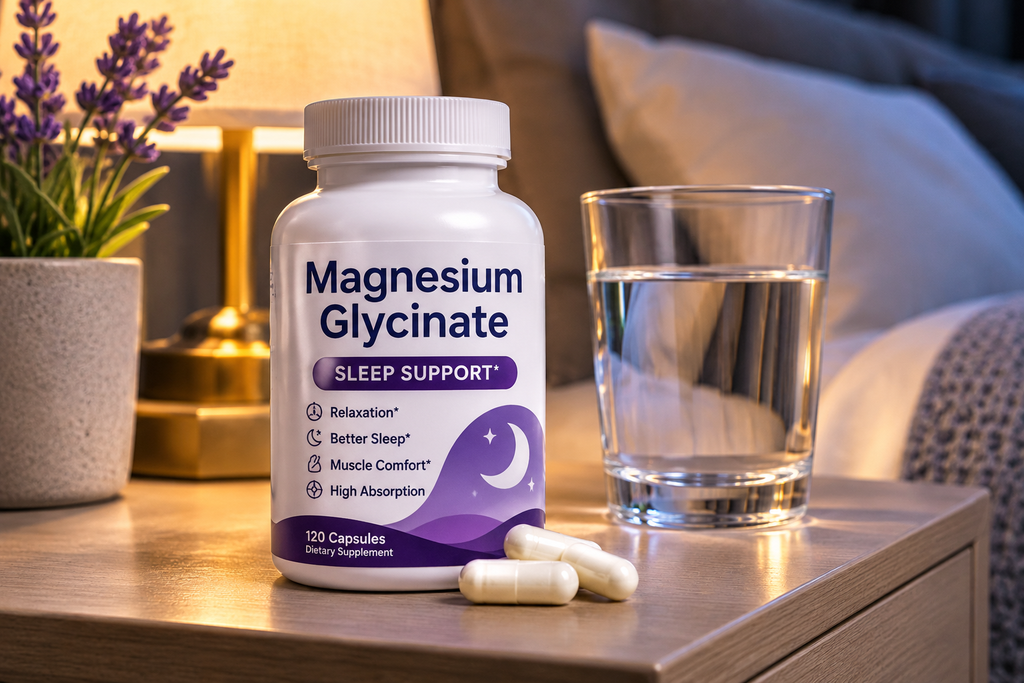
AI-generated illustration of a magnesium glycinate supplement. The packaging and label claims are fictional and do not represent a specific product.What Is Magnesium Glycinate?
Magnesium glycinate is a supplement that combines magnesium with glycine, an amino acid.
Magnesium is an essential mineral involved in hundreds of processes throughout the body, including normal muscle and nerve function.
Glycine also participates in important biological processes and has been investigated separately for possible effects on sleep.
Magnesium glycinate is sometimes called magnesium bisglycinate. These names are commonly used for magnesium bound to glycine, although supplement formulations and labels can vary.
People often choose magnesium glycinate because it is marketed as a relatively gentle form of magnesium that may be easier on the digestive system than certain alternatives.
However, being well tolerated does not automatically mean it is more effective for improving sleep.
Magnesium Glycinate for Sleep: How Long Does It Take to Work?
The most important distinction is between absorbing a supplement and experiencing a measurable improvement in sleep.
Your body can absorb magnesium after you take it, but that does not establish when—or whether—your sleep will improve.
Can magnesium glycinate work on the first night?
Some people report feeling calmer after taking magnesium glycinate in the evening.
However, personal experiences are not reliable evidence of a supplement’s effectiveness.
Changes in sleep can also result from expectations, bedtime routines, daily stress levels and natural variation.
There is currently insufficient evidence to promise that magnesium glycinate will improve sleep within 30 minutes, one hour or even the first night.
What about after one or two weeks?
A 2025 randomised, double-blind, placebo-controlled trial investigated magnesium bisglycinate in adults reporting poor sleep.
The researchers observed improvements in self-reported insomnia symptoms during the study, with much of the improvement occurring within the first two weeks.
However, participants receiving the placebo also improved.
That distinction matters because it shows why improvements during a study cannot automatically be attributed entirely to the supplement.
What happens after four weeks?
The same study found a modest advantage for magnesium bisglycinate over placebo after four weeks.
Participants taking magnesium bisglycinate experienced an average reduction of 3.9 points on the Insomnia Severity Index, compared with 2.3 points in the placebo group.
The difference was statistically significant, but the effect was small.
This suggests that magnesium bisglycinate may help some adults experiencing sleep difficulties, but it is not a guaranteed solution.
Bottom line: Four weeks is a useful research reference point, not a proven waiting period or a recommendation to self-treat insomnia for that length of time.
What Does Scientific Research Say?
Research on magnesium and sleep has produced inconsistent findings.
One reason is that studies have used different magnesium formulations, participant groups, doses and methods of measuring sleep.
The 2025 magnesium bisglycinate trial
A study published in Nature and Science of Sleep in August 2025 enrolled 155 adults aged 18–65 who reported poor sleep.
Participants were assigned to receive either magnesium bisglycinate or a placebo.
The supplement group received 250 mg of elemental magnesium daily, taken approximately 30–60 minutes before bedtime.
After four weeks, the researchers reported a small but statistically significant improvement in insomnia severity compared with placebo.
The study had several limitations.
Sleep outcomes relied on participants’ reports rather than objective sleep measurements. The trial lasted only four weeks, and its findings may not apply to people with diagnosed sleep disorders or significant medical conditions.
The researchers also noted that further studies are needed to understand who might benefit most.
What does the broader evidence show?
A 2026 systematic review of randomised controlled trials found that results for magnesium supplementation and sleep were inconsistent.
The reviewers rated the certainty of evidence as low to very low and concluded that current evidence does not support oral magnesium as a routine treatment for insomnia.
This is an important finding.
Although individual studies suggest possible benefits, the overall evidence is not strong enough to recommend magnesium supplements as a reliable insomnia treatment.
Our assessment: Magnesium glycinate is worth understanding, but claims that it reliably produces deeper sleep, eliminates nighttime waking or works within a specific number of minutes go beyond the available evidence.
Why Might Magnesium Affect Sleep?
Magnesium supports several normal functions that are relevant to sleep.
1. Nervous system function
Magnesium contributes to normal nerve signalling.
Researchers have investigated whether magnesium status influences biological pathways involved in relaxation and sleep regulation.
However, a plausible biological mechanism does not prove that taking extra magnesium improves sleep in people who already consume enough.
2. Muscle function
Magnesium is necessary for normal muscle function.
People sometimes associate magnesium supplementation with reduced muscle tension or greater physical relaxation.
Nevertheless, evidence that magnesium glycinate consistently improves sleep through muscle relaxation remains limited.
3. Magnesium deficiency
Magnesium deficiency can affect normal body function.
People with inadequate magnesium intake may have different responses to supplementation than those whose intake is already sufficient.
The 2025 trial reported exploratory findings suggesting that participants with lower dietary magnesium intake might experience greater improvements.
These findings are preliminary and should not be treated as proof.
Magnesium Glycinate vs Other Types of Magnesium
Magnesium supplements come in several forms.
| Magnesium form | Common characteristics | Evidence for sleep |
|---|---|---|
| Magnesium glycinate | Magnesium combined with glycine | Limited direct evidence; one 2025 trial found a modest benefit |
| Magnesium citrate | Commonly used magnesium form; can have a laxative effect | Insufficient evidence that it is superior for sleep |
| Magnesium oxide | Widely available; generally less readily absorbed than several other forms | No convincing evidence of superior sleep benefits |
| Magnesium chloride | Available in oral supplements | Limited direct evidence for insomnia |
| Magnesium L-threonate | Marketed for cognitive and sleep-related benefits | More research is needed before drawing firm conclusions |
Which is best for sleep?
There is currently insufficient high-quality evidence to declare one magnesium formulation the best for treating insomnia.
The most suitable supplement, if one is needed, depends on factors such as dietary intake, tolerability, medical history and professional advice.
When Should You Take Magnesium Glycinate?
Many supplement labels recommend taking magnesium glycinate in the evening.
In the 2025 clinical trial, participants took magnesium bisglycinate approximately 30–60 minutes before bedtime.
However, this was the study protocol—not proof that this timing is optimal for everyone.
There is no well-established evidence that taking magnesium glycinate exactly one hour before bed is more effective than taking it at another time.
If you use a magnesium supplement, follow the product instructions and any advice from your pharmacist or healthcare professional.
Consistency may be useful when evaluating your experience, but avoid increasing the dose simply because you do not notice an immediate effect.
How Much Magnesium Glycinate Should You Take?
One common source of confusion is the difference between the weight of magnesium glycinate and the amount of elemental magnesium it contains.
For example, a product may advertise a large quantity of magnesium glycinate while supplying a much smaller amount of elemental magnesium.
The elemental magnesium amount is the figure to examine when assessing your magnesium intake.
What did researchers use?
The 2025 trial used 250 mg of elemental magnesium daily.
That does not mean 250 mg is the correct dose for everyone.
It is a description of what researchers studied, not an individual dosing recommendation.
US and UK guidance
In the United States, the National Institutes of Health identifies 350 mg per day as the tolerable upper intake level for magnesium from supplements and medications in adults, unless otherwise directed by a healthcare professional.
This limit does not include magnesium naturally present in food.
UK guidance differs. The NHS advises that taking 400 mg or less of magnesium per day from supplements is unlikely to cause harm for most adults.
These figures are not recommended doses for improving sleep.
If you are considering supplementation, particularly alongside other products containing magnesium, check the total amount and seek professional advice where appropriate.
Does Magnesium Glycinate Have Side Effects?
Magnesium supplements can cause side effects, particularly at higher doses.
Possible effects include:
- Diarrhoea
- Nausea
- Abdominal discomfort
- Stomach cramping
Excessive magnesium intake can be dangerous.
People with impaired kidney function may be at particular risk because their bodies may have difficulty removing excess magnesium.
Magnesium supplements can also interact with certain medicines, including some antibiotics and medications used to treat osteoporosis.
If you take prescription medication, ask a pharmacist or healthcare professional whether magnesium supplementation is appropriate and whether doses need to be separated.
Pregnant or breastfeeding readers should seek individual medical advice before using supplements for sleep.
Who Might Benefit From Magnesium Glycinate?
Magnesium supplementation may be relevant for people who have inadequate magnesium intake or a clinically identified deficiency.
However, the decision to supplement should be based on individual circumstances rather than the assumption that everyone with poor sleep needs more magnesium.
People experiencing persistent insomnia should not rely on supplements alone.
Sleep problems may be associated with stress, irregular work schedules, medication effects, sleep apnoea, restless legs syndrome or other conditions.
Identifying the underlying cause is often more useful than repeatedly trying different supplements.
Magnesium Glycinate vs Sleep Supplement Blends
Magnesium glycinate is a single-ingredient mineral supplement.
Other sleep products contain combinations of ingredients, such as amino acids, botanical extracts or melatonin.
These blends may appeal to people looking for a different approach, but combining ingredients does not automatically make a product more effective.
Each ingredient—and ideally the finished formulation—needs to be evaluated for evidence, safety and potential interactions.
For a closer comparison, read our guide:
YU Sleep vs Magnesium Glycinate: Which Is Better for Sleep?
You can also explore our broader article:
Best Sleep Supplements in 2026: What Actually Works According to Science?
When comparing products, consider the quality of evidence, ingredient amounts, potential interactions, price and whether the product is appropriate for your circumstances.
What Else Can You Do to Improve Sleep?
Supplements are only one small part of the sleep conversation.
For many people, improving sleep habits and addressing underlying problems may be more useful.
Helpful approaches include:
Maintain a consistent sleep schedule
Try to keep your sleep and wake times reasonably consistent.
This helps reinforce your body’s natural sleep–wake rhythm.
Reduce late caffeine intake
Caffeine can remain active for hours after consumption.
If you struggle to fall asleep, consider whether afternoon or evening caffeine is contributing.
Create a comfortable sleep environment
A dark, quiet and comfortably cool bedroom can support sleep.
Manage evening light exposure
Bright light late in the evening may interfere with your body’s normal sleep timing.
Seek help for persistent insomnia
If you regularly struggle to sleep or experience significant daytime impairment, speak with a healthcare professional.
Cognitive behavioural therapy for insomnia (CBT-I) is an established first-line treatment for chronic insomnia.
Magnesium supplements should not replace appropriate diagnosis or treatment.
Frequently Asked Questions
Does magnesium glycinate make you sleepy immediately?
There is no convincing evidence that magnesium glycinate reliably causes immediate sleepiness. Some people report feeling more relaxed, but that is not the same as demonstrating a measurable sleep benefit.
How long should I wait to see whether magnesium glycinate helps?
There is no established waiting period. A 2025 clinical trial measured outcomes over four weeks and found a modest benefit. Speak with a healthcare professional about whether supplementation is appropriate rather than continuing indefinitely without benefit.
Is magnesium glycinate better than melatonin?
The two products are different. Magnesium is an essential mineral, while melatonin is a hormone involved in sleep timing. Their suitability depends on the problem being addressed. Melatonin is prescription-only in the UK, whereas it is sold as a dietary supplement in the US.
Can I take magnesium glycinate every night?
Whether daily supplementation is appropriate depends on your magnesium intake, dose, kidney function, medications and other health factors. Follow professional guidance rather than assuming that long-term use is risk-free.
Can magnesium glycinate help me stay asleep?
Evidence is insufficient to conclude that magnesium glycinate reliably prevents nighttime waking. Some studies report improvements in subjective insomnia symptoms, but this does not establish consistent benefits for every aspect of sleep.
Is magnesium glycinate good for anxiety-related sleep problems?
Magnesium is involved in normal nervous system function, but evidence is insufficient to recommend magnesium glycinate as a treatment for anxiety or anxiety-related insomnia. Persistent anxiety or sleep difficulties deserve appropriate professional assessment.
Final Verdict: Is Magnesium Glycinate Worth Trying for Sleep?
Magnesium glycinate is a widely available supplement with a plausible biological connection to normal nervous system function.
However, scientific evidence for its effectiveness as a sleep aid remains limited.
A 2025 randomised controlled trial found modest improvements in insomnia symptoms after four weeks, while a broader 2026 review concluded that evidence for magnesium supplementation as a routine insomnia treatment remains insufficient.
There is also no scientifically established number of minutes or days within which magnesium glycinate should begin improving sleep.
Our conclusion: Magnesium glycinate may offer modest benefits for some individuals, particularly where magnesium intake is inadequate, but it should not be presented as a proven or fast-acting insomnia treatment.
For persistent sleep difficulties, investigating the underlying cause and using evidence-based treatments is likely to be more valuable than relying on supplements alone.
References
- Schuster, J., Cycelskij, I., Lopresti, A. and Hahn, A. (2025). Magnesium Bisglycinate Supplementation in Healthy Adults Reporting Poor Sleep: A Randomized, Placebo-Controlled Trial. Nature and Science of Sleep, 17, pp. 2027–2040. DOI: 10.2147/NSS.S524348.
- Lopresti, A.L., Smith, S.J. and Drummond, P.D. (2026). Magnesium Supplementation for Sleep in Adults: A Systematic Review of Randomized Controlled Trials. Journal of Dietary Supplements, 23(5), pp. 553–581. DOI: 10.1080/19390211.2026.2719670.
- National Institutes of Health, Office of Dietary Supplements. Magnesium: Fact Sheet for Health Professionals.
- National Center for Complementary and Integrative Health. Sleep Disorders and Complementary Health Approaches: Usefulness and Safety.
- NHS. Vitamins and Minerals: Others — Magnesium.