Affiliate disclosure: This article contains affiliate links. If you purchase through these links, Sleep Choice Lab may earn a commission at no additional cost to you. Affiliate relationships do not influence our editorial conclusions.
Last reviewed: 24 October 2026
Quick Answer: What Are the Best Sleep Supplements?
The best sleep supplements depend on the sleep problem you’re trying to address. Melatonin has evidence for certain problems involving the body’s internal clock, while L-theanine has shown promising results for some aspects of sleep quality. Magnesium, valerian and tart cherry have also been studied, but the findings are less conclusive.
No supplement has been proven to work for everyone, and supplements are not a replacement for appropriate treatment of persistent insomnia.
At Sleep Choice Lab, we believe the best approach is to compare ingredients, clinical evidence, safety and product transparency rather than relying on advertising claims.
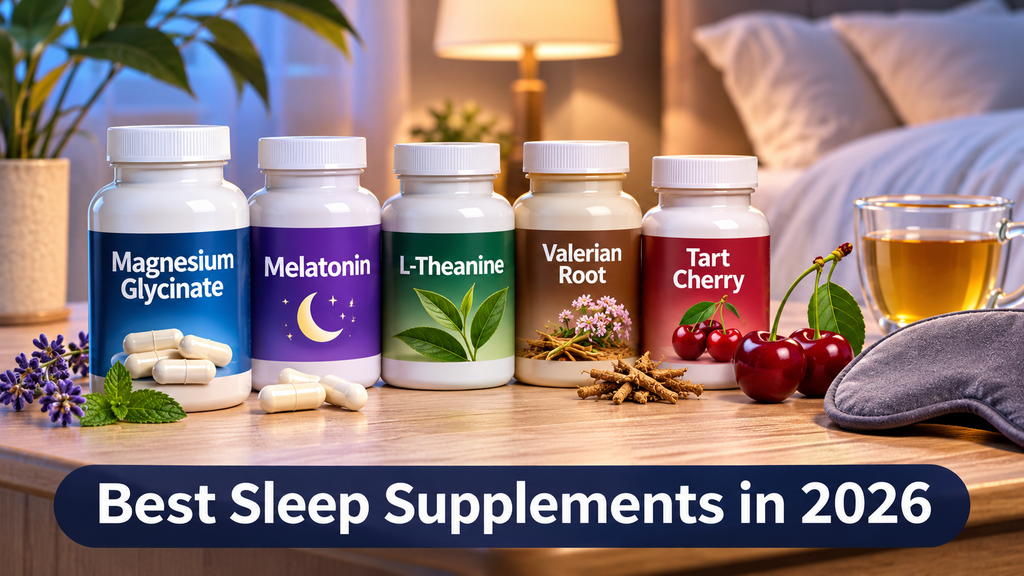
AI-generated illustration of common sleep supplement ingredients. Bottles are illustrative and do not represent specific commercial products.Best Sleep Supplements in 2026: Comparison Table
| Supplement | Main reason people use it | What research suggests | Important limitation |
|---|---|---|---|
| Melatonin | Sleep timing and jet lag | Evidence supports some circadian-rhythm uses | Not routinely recommended for chronic insomnia |
| Magnesium glycinate | Relaxation and sleep quality | Some promising findings, but evidence remains limited | Benefits may depend on individual circumstances |
| L-theanine | Relaxation and sleep quality | Recent reviews suggest modest improvements | More high-quality studies are needed |
| Valerian root | Falling asleep and relaxation | Inconsistent clinical results | Effectiveness for insomnia is unproven |
| Tart cherry | Sleep duration and quality | Small studies show mixed findings | Results vary by formulation and population |
| YU Sleep | Convenient multi-ingredient sleep support | Some ingredients have relevant research | Limited verified evidence for the complete formula |
This table compares the strength and limitations of the available evidence. It is not a ranking of clinically proven treatments.
1. Melatonin: Best Studied for Sleep Timing
Melatonin is a hormone naturally produced by the body. It helps regulate the circadian rhythm, the internal biological clock that influences when we feel sleepy and awake.
Supplemental melatonin has been studied for several sleep-related conditions, including jet lag and delayed sleep-wake phase disorder.
Research suggests that melatonin can help with some sleep-timing problems. However, evidence supporting its routine use for chronic insomnia is insufficient.
Who Might Consider Melatonin?
People experiencing certain circadian-rhythm problems may benefit from discussing melatonin with a healthcare professional.
Timing matters. Taking melatonin at an inappropriate time may be ineffective or interfere with the desired adjustment of the sleep schedule.
Melatonin Safety
Possible side effects include headaches, dizziness, nausea and daytime sleepiness.
Melatonin may also interact with medications. Its long-term safety is not well established.
UK readers should note that melatonin is a prescription-only medicine in the United Kingdom, rather than an ordinary over-the-counter dietary supplement.
Evidence verdict: One of the better-studied options for certain sleep-timing problems, but not a universal insomnia treatment.
2. Magnesium Glycinate: A Popular Option With Limited Evidence
Magnesium is an essential mineral involved in normal nerve and muscle function.
Magnesium glycinate combines magnesium with glycine and is frequently marketed as a supplement for relaxation and sleep.
Some studies suggest that magnesium supplementation may modestly improve certain sleep outcomes. However, research findings are mixed, and the evidence is not strong enough to conclude that magnesium glycinate reliably treats insomnia.
What Should You Look For?
When comparing magnesium supplements, check whether the label clearly states the amount of elemental magnesium per serving.
This matters because the weight of magnesium glycinate is not the same as the amount of magnesium it supplies.
A transparent label makes it easier to compare products and assess your total supplemental intake.
Magnesium Safety
Higher supplemental magnesium intakes can cause diarrhoea, nausea and abdominal cramping.
Magnesium may interact with certain medicines, and people with kidney problems should seek medical advice before taking supplements.
Evidence verdict: Worth investigating, particularly when magnesium intake is inadequate, but not a proven standalone treatment for insomnia.
3. L-Theanine: Promising Research for Sleep Quality
L-theanine is an amino acid naturally found in tea.
It is commonly marketed for relaxation and stress management without the same sedating effects associated with some sleep medicines.
A 2025 systematic review and meta-analysis examined 19 studies involving 897 participants. The researchers reported improvements in several subjective sleep outcomes, including overall sleep quality.
However, the authors also highlighted important limitations and called for more research on L-theanine taken by itself.
Does L-Theanine Help You Fall Asleep?
Some studies suggest that L-theanine may modestly improve how people perceive their sleep.
That does not mean it reliably treats clinical insomnia or produces the same results for everyone.
Different studies have used different doses, populations and formulations.
L-Theanine Safety
L-theanine has generally been well tolerated in research, but long-term safety and interactions are not fully established.
Anyone taking medication or managing a medical condition should seek professional advice before combining supplements.
Evidence verdict: Promising for some aspects of sleep quality, although further research is needed.
4. Valerian Root: Traditional Use, Inconsistent Results
Valerian is an herb traditionally used to support relaxation and sleep.
It appears in numerous herbal sleep products, sometimes alongside lemon balm or other botanical ingredients.
Despite its popularity, clinical research has produced inconsistent results.
The US National Center for Complementary and Integrative Health reports that valerian’s effectiveness for insomnia has not been demonstrated.
Is Valerian Worth Trying?
Some people report subjective benefits, but personal experiences are not sufficient evidence that a supplement consistently improves sleep.
Products may also differ substantially in extract strength and composition.
Valerian Safety
The long-term safety of valerian remains uncertain.
Combining sedating herbs with alcohol, sleep medicines or other substances that cause drowsiness may increase risks.
Evidence verdict: Traditional popularity exceeds the strength of the clinical evidence.
5. Tart Cherry: Interesting but Preliminary Research
Tart cherry products have attracted attention because of their potential effects on sleep-related outcomes.
Studies have examined tart cherry juice, concentrates and capsules.
Some small trials have reported improvements in sleep measures, but findings are inconsistent.
A recent systematic review and meta-analysis found no statistically significant overall improvement in sleep quality across the included trials, although a small subgroup of studies involving people with insomnia showed more encouraging results.
These findings suggest that further research is justified, not that tart cherry has been proven to treat insomnia.
What Makes Tart Cherry Difficult to Compare?
Different products may contain very different concentrations of tart cherry compounds.
A result from a study using a specific juice preparation cannot automatically be applied to a capsule or proprietary blend.
Evidence verdict: Interesting early research, but insufficient evidence for strong claims about sleep benefits.
6. YU Sleep: A Multi-Ingredient Alternative
YU Sleep takes a different approach from supplements containing only one main active ingredient.
According to the product information reviewed, a 2 mL serving contains:
- Melatonin: 0.9 mg
- Vitamin B2: 0.5 mg
- Vitamin B6: 0.5 mg
- A proprietary blend: 637 mg
The proprietary blend lists red tart cherry concentrate, magnesium glycinate, apigenin, lemon balm extract, 5-HTP, L-theanine and GABA.
The appeal is convenience: several ingredients are combined into a single liquid supplement.
However, more ingredients do not necessarily mean better results.
What Are the Main Limitations?
YU Sleep does not separately disclose the quantities of the seven ingredients in its proprietary blend.
This makes it difficult to compare its individual ingredient doses with those used in clinical trials.
At the time of this review, we could not verify a published, peer-reviewed, placebo-controlled human trial establishing the effectiveness of the complete YU Sleep formula.
Research on melatonin, magnesium or L-theanine cannot automatically establish the effectiveness of their combination in YU Sleep.
Important Safety Considerations
YU Sleep contains melatonin and 5-HTP.
5-HTP may interact with medications that increase serotonin, including certain antidepressants. Combining serotonergic substances can increase the risk of serious adverse effects.
Consumers should consult a qualified healthcare professional before combining YU Sleep with prescription medication or other sleep supplements.
Is YU Sleep Worth Considering?
YU Sleep may appeal to people who prefer a combined liquid formula over several separate products.
However, its proprietary blend, limited product-specific clinical evidence and potential interactions should be considered before purchasing.
For more detailed information, read our existing reviews:
Does YU Sleep Really Work? Ingredients, Evidence and Side Effects Explained
YU Sleep vs Magnesium Glycinate: Which Is Better for Sleep?
You can also view YU Sleep’s product information and current pricing on the manufacturer’s website (affiliate link).
Note: Product availability and legal requirements vary by country. Check local rules before ordering melatonin-containing products.
Which Sleep Supplement Has the Strongest Scientific Evidence?
There is no single winner for every sleep problem.
For sleep timing: Melatonin has relevant clinical evidence for some circadian-rhythm conditions.
For subjective sleep quality: L-theanine has promising research, although further studies are needed.
For magnesium supplementation: Correcting inadequate magnesium intake may be appropriate, but evidence for treating insomnia remains limited.
For herbal approaches: Valerian and tart cherry have less consistent evidence.
For multi-ingredient formulas: Products such as YU Sleep should ideally be evaluated through clinical studies of the complete formula rather than assumptions based on individual ingredients.
The most appropriate option depends on the cause of the sleep problem, medical history, medication use and personal circumstances.
How to Choose a Sleep Supplement
Before purchasing a sleep supplement, consider five factors.
1. Identify the Sleep Problem
Difficulty falling asleep, waking during the night, jet lag and chronic insomnia are different problems.
A supplement studied for one condition may not help another.
2. Look for Human Clinical Research
Prioritise controlled human studies and systematic reviews over testimonials or marketing claims.
A study involving a particular ingredient does not necessarily prove that every product containing it will work.
3. Check Ingredient Transparency
Look for clearly disclosed ingredient amounts.
Proprietary blends can make it difficult to assess whether a product contains quantities comparable with those studied in research.
4. Consider Medication Interactions
Natural supplements can interact with prescription medicines.
This is especially important for products containing melatonin, 5-HTP or multiple ingredients that may cause drowsiness.
5. Compare Cost Per Serving
A higher price does not guarantee better effectiveness.
Compare the number of servings, ingredient transparency and evidence rather than focusing only on promotional discounts.
Are Sleep Supplements Better Than Improving Sleep Habits?
For persistent insomnia, supplements should not be viewed as a replacement for evidence-based treatment.
Cognitive behavioural therapy for insomnia (CBT-I) is widely recommended as a first-line treatment for chronic insomnia.
Other useful approaches may include maintaining a consistent sleep schedule, managing light exposure, limiting late caffeine intake and addressing environmental disturbances.
People who snore heavily, experience breathing interruptions during sleep or remain excessively sleepy during the day should seek medical assessment.
Frequently Asked Questions
What Is the Best Sleep Supplement for Falling Asleep?
There is no universally best supplement. Melatonin may help certain sleep-timing problems, while L-theanine has shown promising results for subjective sleep outcomes. Persistent difficulty falling asleep warrants assessment of the underlying cause.
Is Magnesium Glycinate Better Than Melatonin?
They serve different purposes. Magnesium is an essential mineral, while melatonin helps regulate sleep timing. Neither can be declared universally better for insomnia.
Can You Take Several Sleep Supplements Together?
Combining supplements can increase the risk of side effects or interactions. Consult a qualified healthcare professional before combining products, especially if they contain melatonin, 5-HTP or other ingredients affecting sleep and alertness.
Do Natural Sleep Supplements Have Side Effects?
Yes. Natural ingredients can cause adverse effects, interact with medicines and vary in quality or composition.
How Long Do Sleep Supplements Take to Work?
There is no single answer. Effects depend on the ingredient, formulation, timing and individual circumstances. Product claims about guaranteed or immediate results should be treated cautiously.
Are Sleep Supplements Safe for Long-Term Use?
Long-term safety evidence is limited for many sleep supplements. Persistent sleep problems should be discussed with a healthcare professional rather than managed indefinitely through self-treatment.
Final Verdict: The Best Sleep Supplements in 2026
The best sleep supplements are not necessarily the products containing the most ingredients or making the strongest promises.
Melatonin has useful evidence for certain sleep-timing problems. L-theanine has encouraging research for some aspects of sleep quality. Magnesium, valerian and tart cherry have been studied, but important uncertainties remain.
Multi-ingredient products such as YU Sleep offer convenience, although proprietary blends and limited product-specific clinical evidence make their effectiveness harder to assess.
Our recommendation: Choose based on the actual sleep problem, quality of evidence, ingredient transparency and safety—not advertising claims.
For ongoing insomnia, professional assessment and evidence-based treatment are more important than finding the next supplement.
Scientific Sources and Further Reading
- NCCIH — Sleep Disorders and Complementary Health Approaches
- NCCIH — Melatonin: What You Need To Know
- NHS — About Melatonin
- 2025 Systematic Review — L-Theanine and Sleep Outcomes
- Systematic Review — Tart Cherry Supplementation and Sleep
- NHS — Insomnia
Editorial note: This is an evidence-based comparison of supplement ingredients and product information, not a hands-on product test. The findings do not constitute individual medical advice. Product labels, availability and regulations may change.